

Keyto PEI Diffusion Bonded Manifold | Repeatable Flow Control
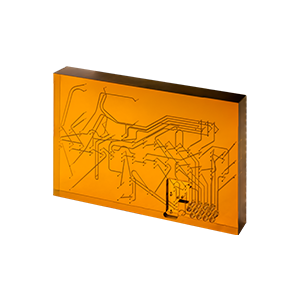
Keyto's bonded manifold is made by molecular bonding of multi-layer processed parts with specific flow path features and supports up to five layers. It integrates functions such as sample addition, dilution, reagent mixing, reaction, separation, and detection, saving reagents and enhancing system integration. The manifold supports multi-level, multi-fluid path designs with material options including PMMA, PEI, and PVC, and offers O-type, square, and D-type flow path structures. Keyto's O-type structure provides large fluidity, low resistance, and minimal dead volume, supported by mature mass production capabilities.
Key Parameters:
Customized
Reference Model:
Manifold-PEI-3
WhatsApp Contact
Online Message
Comparison/Performance
Keyto PEI Diffusion Bonded Manifold | Repeatable Flow Control
Comparable Products
Comparison/Performance
Back
Overview
Keyto PEI Diffusion Bonded Manifold | Repeatable Flow Control
 
Precision-focused design for stable flow resistance and repeatable results.
 
Keyto’s PEI-3 diffusion bonded manifold emphasizes dimensional control and flow repeatability for performance-critical instruments. Multi-layer PEI parts are diffusion bonded to form sealed channels with controlled geometry, enabling stable distribution and routing across multiple functional zones. The structure supports up to five bonded layers and can be configured with square, round, or D-shaped channels to meet resistance and dead-volume targets. With minimum channel features down to 0.5 mm and ±0.01 mm channel tolerance (design dependent), PEI-3 is well-suited for systems requiring consistent behavior across builds and batches.
 

Feature Bullets

  • Precision-oriented channel control for repeatable flow behavior

  • Minimum channel feature down to 0.5 mm; ±0.01 mm channel tolerance (design dependent)

  • Up to 5 bonded layers for compact, complex routing

  • Channel geometry options for fine tuning resistance and dead volume

  • Integrates dilution, mixing, reaction routing, separation, and detection pathways

  • CAD-driven customization with manufacturability and sealing reliability review


FAQ

Q1: How does dimensional tolerance impact system performance?
A: Tight channel tolerance helps stabilize flow resistance and reduces run-to-run variability in dosing and routing behavior.

Q2: Can you support multi-port distribution networks?
A: Yes. Multi-port designs are common, and we can optimize routing to balance resistance across branches.

Q3: Is diffusion bonding the only option?
A: No. We also support solvent, laser, and ultrasonic bonding when they better fit the material/application.

Q4: Can you validate sealing reliability?
A: We can propose verification approaches (e.g., pressure/flow checks) aligned with your application requirements.

 
Demo video
Product video
Factory video
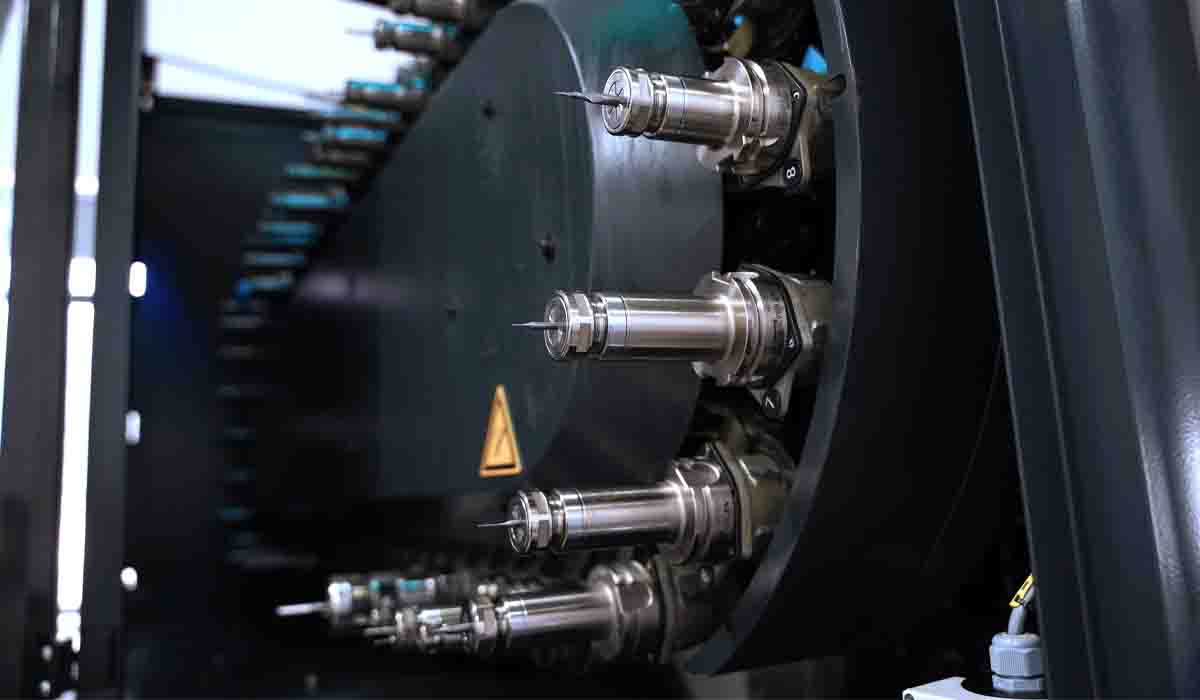
Keyto Machining Factory
Keyto Quality Control (1)
3D Model
3D Model Download
*Please leave your contact information if you want to download confidential documents.
Name
Email
Get Captcha
Captcha
Company
3D Model
3D Model Download
*Please leave your contact information if you want to download confidential documents.
Format
Position
E-Mail