

 language






Modern IVD and scientific instruments require fluidic systems that are compact, reliable, and easy to integrate. As instruments become smaller and more functionally sophisticated, traditional tubing-based fluidic layouts often create challenges in leakage control, dead volume reduction, assembly efficiency, and long-term stability.
A custom bonded manifold offers a more integrated approach. By consolidating complex flow paths into a compact manifold structure, OEM manufacturers can simplify fluid handling architecture, improve system consistency, and support faster product development. For applications in IVD, life science, laboratory automation, and portable analytical devices, bonded manifolds have become an increasingly practical solution for achieving higher integration and lower fluidic risk.
At Keyto, custom bonded manifold solutions are developed for OEM customers who need leak-free fluidic integration, flexible structural design, and one-stop module customization for demanding instrument platforms.
What Is a Custom Bonded Manifold?
A custom bonded manifold, also known as a diffusion bonded manifold, is an integrated fluidic component designed to replace complex tubing assemblies with a more compact and engineered internal flow-path structure. Instead of relying on multiple external tubes, fittings, and joints, the manifold forms the channels directly inside the component body.
This integrated design helps reduce connection points, improve routing precision, and create a cleaner fluidic architecture. For instrument developers, it also helps improve reliability, reduce dead volume, and simplify system assembly.
Why Bonded Manifolds Matter in IVD and Scientific Instruments
Fluid handling systems in diagnostic and scientific instruments often need to manage sample introduction, reagent routing, mixing, reaction control, washing, sensing, and waste handling within a limited space. Traditional tubing layouts can become difficult to manage as system complexity increases.
A bonded manifold helps address these challenges by integrating multiple fluidic functions into one engineered structure. This allows instrument manufacturers to reduce layout complexity, improve repeatability, and support more compact and scalable product designs.
Key Advantages of Keyto Custom Bonded Manifolds
Keyto’s bonded manifold solutions are designed to support fluidic integration, miniaturization, and long-term reliability in advanced instruments.
-
-
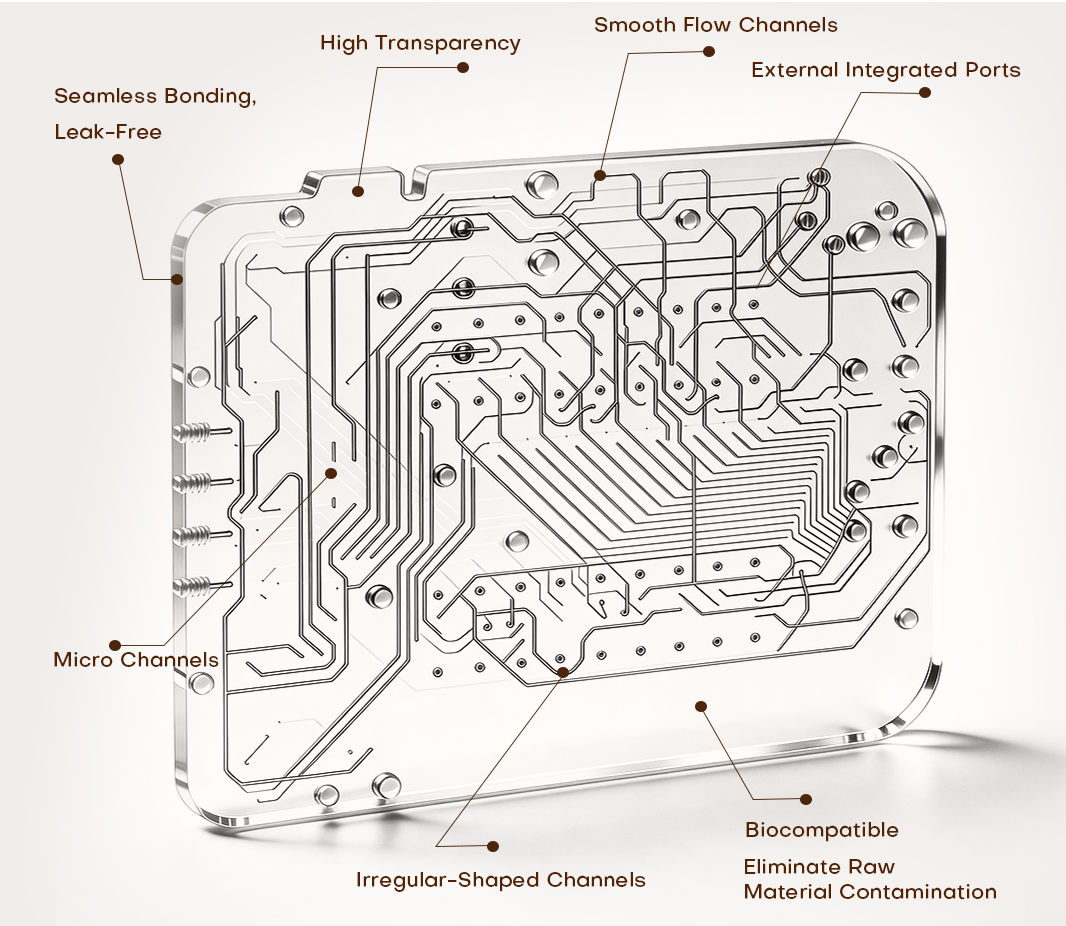
- High transparency
- Smooth internal channels
- Integrated external ports
- Seamless bonding structure
- Leak-free design
- Microchannel capability
- Support for irregular channel geometries
- Material options suitable for biocompatibility-oriented applications
- Reduced risk of source-material contamination
-
These features help OEM customers improve fluidic stability, simplify assembly, and optimize the overall instrument structure.
Custom Parameters
| Parameter | Specification / Option |
|---|---|
| Product Name | Diffusion Bonded Manifold / Bonded Manifold |
| Channel Shape | D-shaped, square, round |
| Bonding Process | Molecular bonding, adhesive bonding, laser bonding |
| Material Options | PMMA, PEI, and other customizable options depending on application |
| Minimum Channel Diameter | 0.2 mm |
| Stacking Capability | Up to 5 layers, customizable by requirement |
| Channel Tolerance | ±0.01 mm |
Single-Layer and Multilayer Structure Options
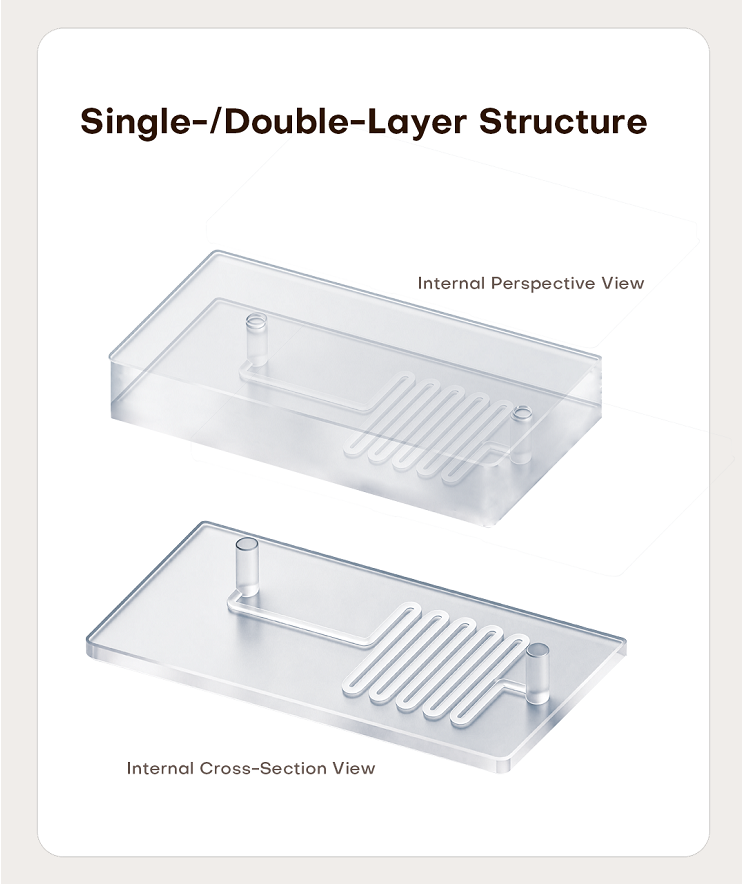
Single or Double-Layer Structure
Single-layer or double-layer structures are suitable for fluidic systems with relatively simple routing and no complex multilayer design requirements. They are often used when the channel layout is straightforward and the instrument does not require advanced stacking or crossover structures.
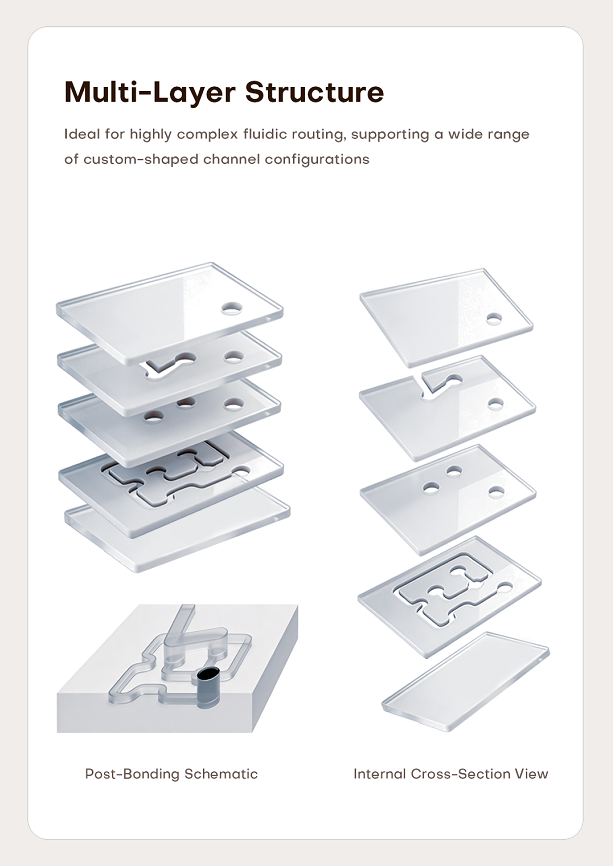
Multilayer Structure
Multilayer structures are more suitable for complex fluidic routing, compact layouts, and irregular channel geometries. They provide greater design flexibility for instruments that require multiple functions within a limited internal space.
Integrated Fluidic Module Solutions
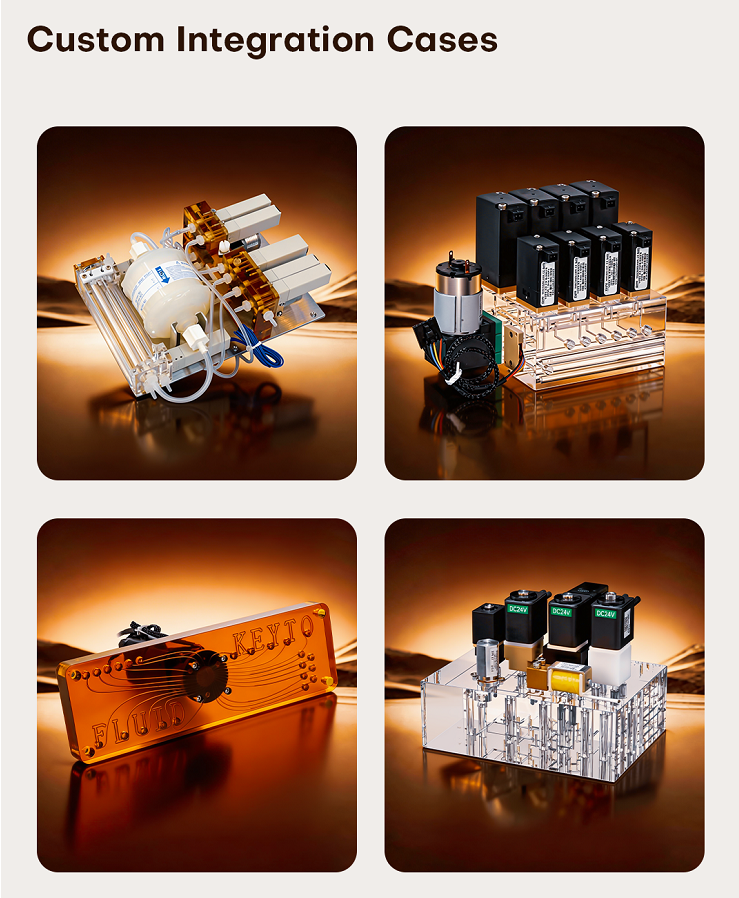
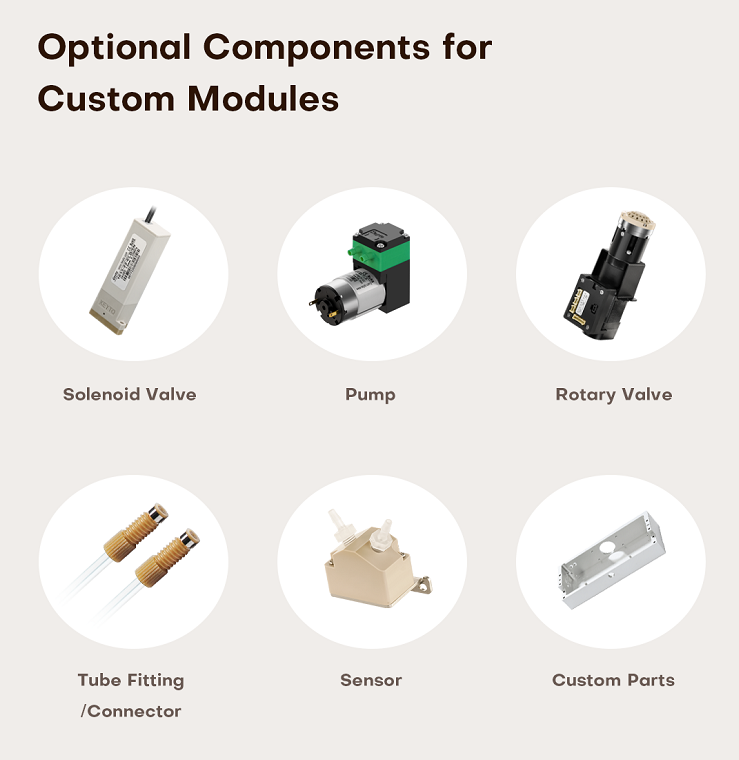
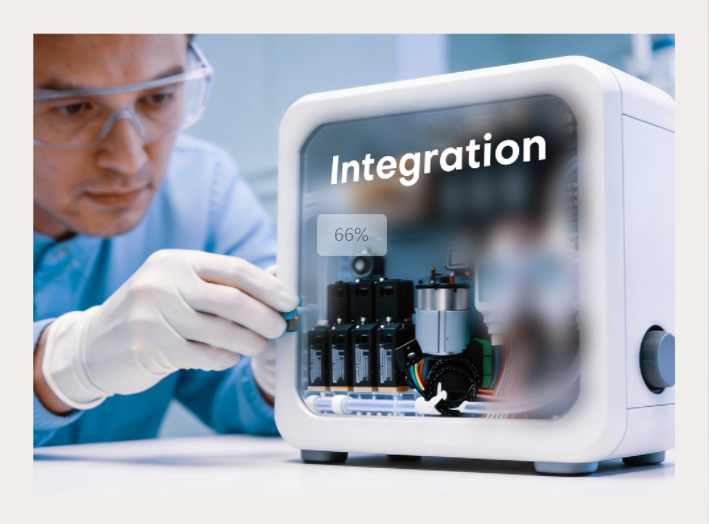
Keyto’s customization capability goes beyond manifold fabrication. By integrating valves, pumps, fittings, sensors, and custom parts into the bonded manifold, Keyto can provide one-stop fluidic subsystem development and module assembly services based on specific OEM requirements.
Optional components for custom integrated modules include:
-
-
-
- Solenoid valves
- Rotary valves
- Pumps
- Fittings and connectors
- Sensors
- Custom machined parts
-
-
This integrated approach helps instrument manufacturers reduce subsystem complexity, improve integration efficiency, and accelerate product development.
Related solutions:
What Problems Can a Bonded Manifold Solve?
1. Fluidic Integration
A highly integrated manifold can combine valves, pumps, fittings, and structural elements into one compact fluidic core. This helps eliminate complicated tubing layouts, reduce leak points, and minimize dead volume.
2. Lower Assembly and Maintenance Cost
Integrated manifold solutions simplify assembly and testing processes, reduce reliance on manual tubing installation, and improve consistency in production.
3. Instrument Miniaturization
Compact modular design helps reduce instrument size, improve internal space utilization, and create more flexibility for future product upgrades and functional expansion.
4. Home Monitoring and Portable Devices
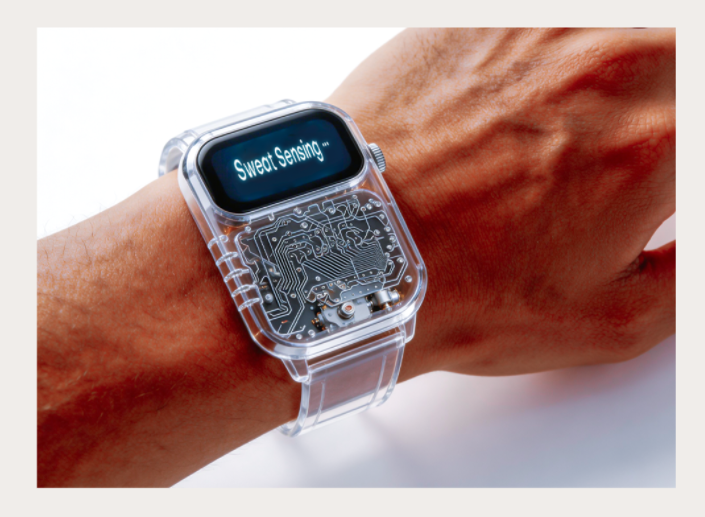
For home-use instruments, portable systems, and wearable applications, compact manifold technology helps reduce internal footprint while maintaining reliable fluid handling. This makes it easier to develop lighter, smaller, and more user-friendly devices.
5. Reduced Development Cycle and Cost
Engineering teams can build standardized module libraries for functions such as liquid delivery, mixing, and detection. This modular approach helps shorten development cycles and improve response speed to market demand.
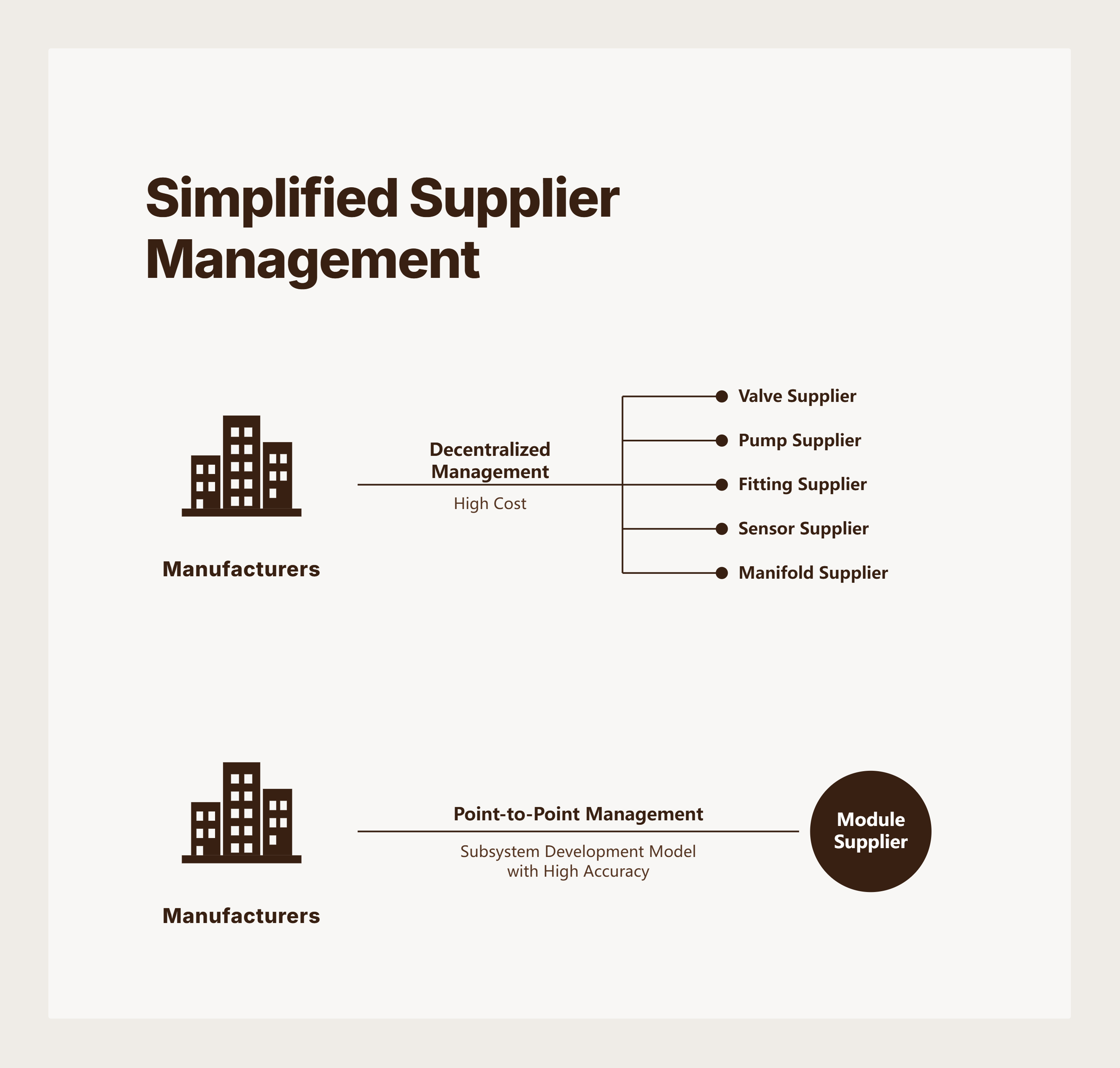
6. Simplified Supplier Management
Replacing a large number of discrete components with integrated modules can simplify procurement, reduce supplier coordination complexity, and improve supply chain efficiency.
PMMA vs PEI Material Options
PMMA Bonded Manifold
PMMA is often selected for applications that require high transparency and good visual observability. It is suitable for systems where optical inspection or visual flow observation is important.
PEI Bonded Manifold
PEI is suitable for applications requiring stronger thermal and structural performance. It is often preferred for more demanding environments where durability and stability are critical.
Material selection should always be based on media compatibility, temperature conditions, pressure requirements, structural needs, and system integration goals.
Typical Application Scenarios
-
-
- IVD analyzers
- Scientific instruments
- Laboratory automation systems
- Life science equipment
- Home testing instruments
- Wearable fluid-monitoring devices
- Compact analytical platforms
-
Recommended external references:
Frequently Asked Questions
Q1: What is the difference between a bonded manifold and a traditional tubing assembly?
A bonded manifold integrates the flow path inside a compact engineered component, while a traditional tubing assembly depends on multiple external tubes, connectors, and joints. The bonded approach helps improve compactness, reduce leak points, and simplify fluidic routing.
Q2: Can a bonded manifold support complex fluidic structures?
Yes. Multilayer bonded manifolds are especially suitable for complex routing, compact layouts, and irregular channel designs.
Q3: What materials are available for custom bonded manifolds?
Common options include PMMA and PEI. The best material depends on optical, thermal, mechanical, and media-compatibility requirements.
Q4: What channel shapes can be customized?
Typical channel shapes include D-shaped, square, and round channel structures, depending on the fluidic design requirements.
Q5: Can Keyto provide full module integration support?
Yes. Keyto can integrate valves, pumps, fittings, sensors, and custom parts into a bonded manifold-based module according to OEM project needs.
Q6: Which industries are most suitable for bonded manifold solutions?
Bonded manifold solutions are especially suitable for IVD, life science instrumentation, laboratory automation, analytical instruments, and compact home-monitoring devices.
Conclusion
A custom bonded manifold is more than a fluidic component. It is a system-level solution for OEMs seeking better fluidic integration, lower leakage risk, reduced assembly complexity, smaller instrument size, and faster product development.
With customization options in material, channel geometry, bonding process, and module integration, Keyto helps instrument manufacturers build reliable and scalable fluidic subsystems for demanding applications. For OEM teams developing new IVD or scientific instrument platforms, a custom bonded manifold can provide a more compact, efficient, and dependable fluidic foundation.