


 language

-
Home
-
Products and Solutions
-
Keyto Global
-
News Center
-
Service Support
-
About Us
-
Contact Us
-
Language

For engineers and technical buyers developing automated instruments
For an OEM team comparing a positive displacement pipette vs air displacement pipette, the starting point is the liquid and the transfer requirement. Air displacement is a practical candidate for water-like liquids under controlled conditions. Positive displacement deserves early evaluation when viscosity, volatility or temperature differences make an air cushion difficult to control. These are starting points for selection, not guarantees of performance. Eppendorf liquid handling overview
This guide is for engineers and technical buyers developing automated instruments. It compares the operating principles, then adds the consumable, motion, sensing and validation questions needed to select an OEM module. Keyto products discussed here are air displacement modules for integration into instruments.
The terms describe different aspects of liquid handling. Identify what separates the actuator from the liquid and how the system meters a dose before comparing specifications.
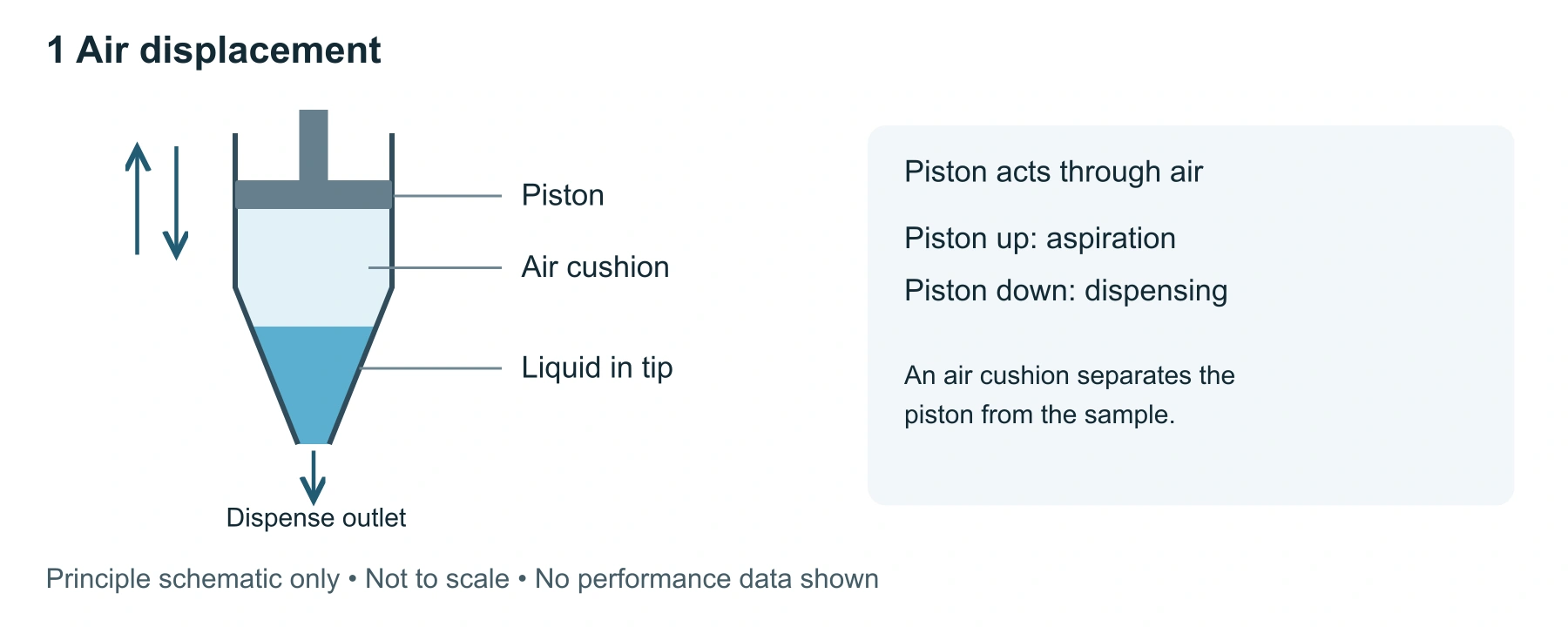
An air displacement pipette has an air cushion between its piston and the liquid in the tip. Piston movement changes the air pressure to aspirate or dispense. Because the piston acts through air, liquid properties and operating conditions can affect the transferred volume.
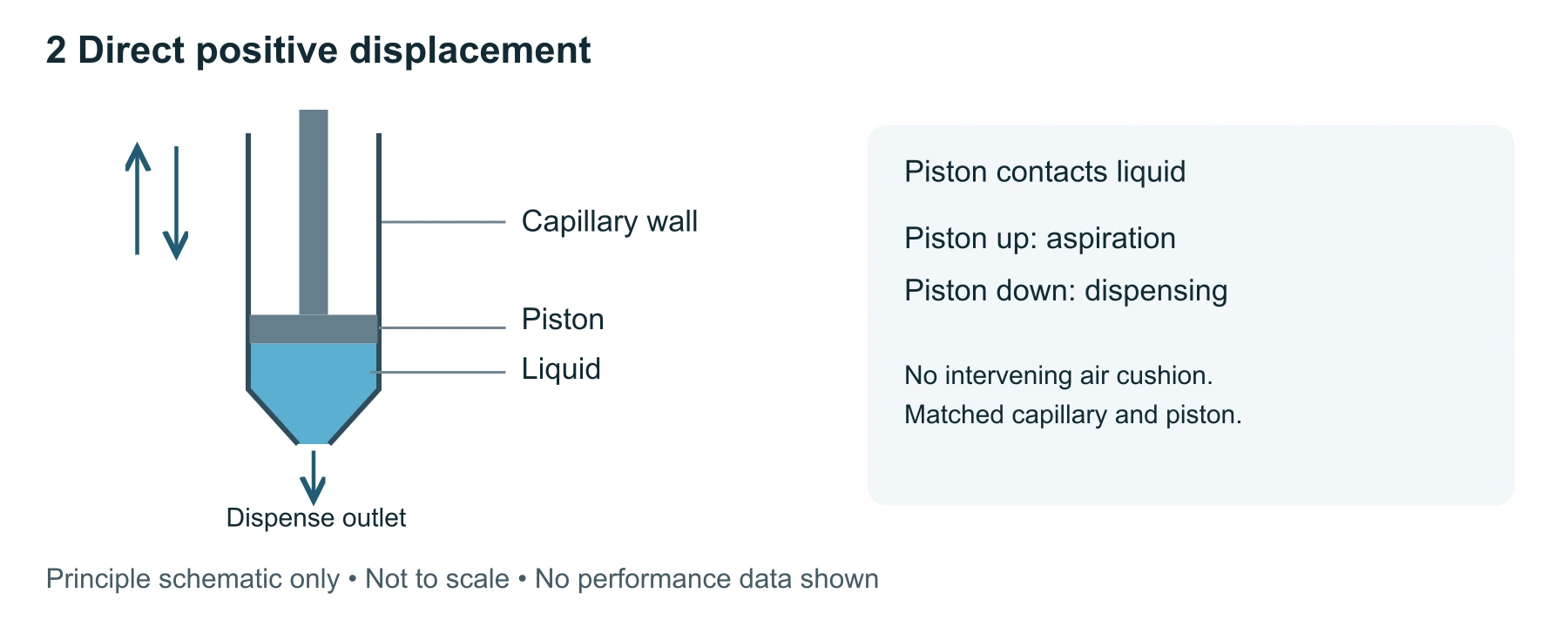
In a positive displacement pipette, the piston contacts the liquid directly inside a matched capillary or tip. Its movement meters the liquid without an intervening air cushion. This requires a different consumable and actuation arrangement from a conventional air displacement tip. Figures 1 and 2 summarize the principles described in Thermo Fisher’s pipette comparison.
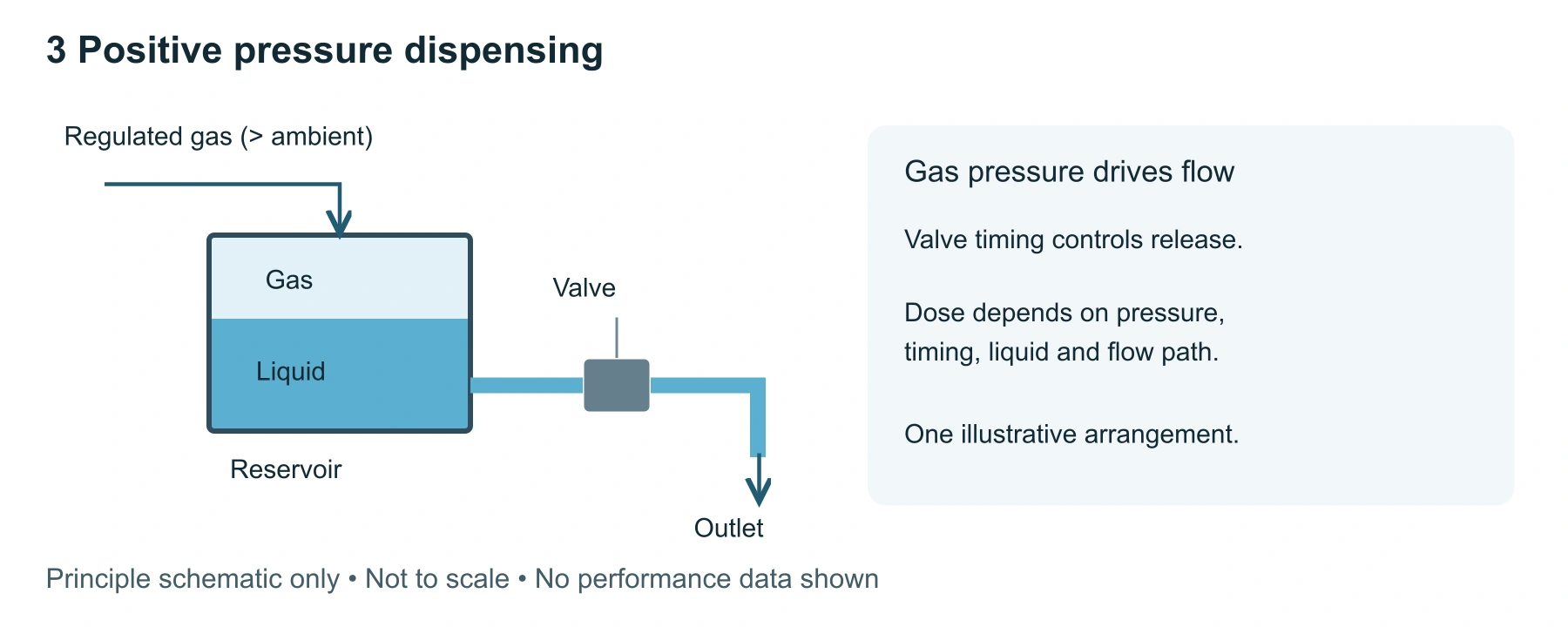
Positive pressure means pressure above a reference, usually ambient. In the illustrated arrangement, regulated gas pressure pushes liquid from a reservoir through a valve and outlet. Delivered volume depends on pressure, valve timing and the flow path, including the liquid’s viscosity. This is a separate metering arrangement from a piston contacting the liquid. Festo pressure dispensing white paper
Use the matrix below to decide which route to test first. The physical principles are source-backed; the suggested OEM test priorities are engineering recommendations, not results from a comparative trial.
| Condition | Air displacement vs positive displacement | What to test in the instrument |
|---|---|---|
| Water-like liquids at stable temperature | Air displacement is a reasonable starting point. Positive displacement remains an option if other requirements favor it. | Actual reagents, target volumes and selected tips at the required cycle time. |
| High viscosity or slow flow | Air displacement may require slower aspiration, additional dwell or reverse pipetting. Evaluate positive displacement when those adjustments cannot meet the requirement. | Filling time, retained liquid, dispensing completeness and repeatability. |
| High volatility | Evaporation into the air cushion can disturb air displacement. Direct displacement removes that air-cushion mechanism. | Dripping and delivered volume after realistic delays between aspiration and dispense. |
| Hot or cold liquid relative to the module | Temperature differences can alter an air cushion. Positive displacement reduces this source of sensitivity; materials and temperature limits still apply. | Liquid and module temperatures, warm-up behavior and transfers across the operating range. |
| Small transfers or a wide volume span | Neither principle guarantees acceptable results at every volume. Select the tip and metering range around the critical transfer points. | Minimum, routine and maximum doses, including the first and last aliquots in repeated dispensing. |
There is no universal viscosity or solvent-content threshold that selects the right module. Tip geometry, aspiration speed and dispense speed also matter, including in positive displacement systems. Eppendorf Application Note 211
Where those trials support air displacement, proceed to OEM air displacement pipetting modules and compare configurations against the instrument requirements.
A successful liquid transfer is only part of the selection. The instrument must also pick up the consumable, reach the sample, detect relevant faults and recover predictably. OEM air displacement platforms already include combinations of tip sensing, pressure monitoring and optional motion integration, as illustrated by Tecan’s Cavro ADP. Evaluate which capabilities the proposed configuration supplies and which the host instrument must implement.
Use this OEM pipetting integration checklist before requesting a quotation:
| Constraint | Air displacement questions | Positive displacement questions |
|---|---|---|
| Tips and consumables | Which exact tips provide reliable fit and sealing? Are filters, conductive tips and alternative suppliers qualified? | Which capillary-piston assemblies are supported? How are they loaded, engaged, removed and supplied? |
| Motion axes | What Z-axis stroke, alignment and pickup/ejection force are required? Does the head fit the deck and channel spacing? | What motion and coupling engage the piston? Can the robot accommodate the consumable length and actuator travel? |
| Sensors and recovery | Which tip, liquid-level and aspiration signals are available? Which faults can the host detect from them? | How are consumable engagement, piston travel and unsuccessful transfers detected? What recovery is possible? |
| Cleaning and carryover | Which surfaces may become wetted after over-aspiration or a spill? How are tips, waste and exposed surfaces managed? | Which parts contact the sample? Are they replaced or cleaned, and how is residual contamination assessed? |
| Interfaces and service | Confirm power, protocol, commands, fault codes, calibration access and service parts for the quoted configuration. | Confirm the same requirements, including actuator control, consumable-state reporting and seal maintenance where applicable. |
Compare cost and throughput at the workflow level. Include consumables, tip changes, dwell times, washing where required, maintenance and recovery from failed transfers. A fast dispense specification does not establish the number of acceptable transfers an instrument can complete per hour.
Keyto’s air displacement category lists several OEM modules. Use the following published ranges and configuration differences to form a shortlist, then confirm the exact ordering configuration. A listed range is not evidence that every liquid performs equally well across that range.
| Candidate and product link | Published pipetting range | Reason to investigate this candidate |
|---|---|---|
| SP13 | 0.5–1000 µL | Published 9 mm tip spacing, pressure and capacitive liquid-level detection, and HSZ compatibility. |
| SP18P | 2–1000 µL | Pressure and capacitive liquid-level detection with HSZ compatibility. Confirm channel layout against the controlled drawing. |
| SP20 | 5–1000 µL | Published pressure-based liquid-level detection and Z180 compatibility; check controller, volume and probe options. |
| SP28 | 5–1000 µL | Several functional options. Confirm tip sensing, liquid-level detection and aspiration monitoring in the selected option. |
The SP13 page also reports water-test reference points attributed to its manual: at 5 µL with a 50F tip, 5% accuracy and 2% CV; at 1000 µL with a 1000F tip, 1% accuracy and 0.75% CV. These retain the manufacturer’s “accuracy” label. Request the underlying error definition, complete conditions and applicable document revision before using them as acceptance criteria. SP13 published performance information
Figures 1–3 explain mechanisms. The condition matrix guides test priorities. The model table summarizes published specifications, and the SP13 values are manufacturer-reported water references. None substitutes for an application validation record.
For a project-specific evaluation, agree on the hardest transfer conditions and pass/fail limits before testing. Record the following:
Report systematic error separately from repeatability. For a proposed volume-based report, define:
State units, exclusions and acceptance limits. Assess carryover separately using a defined challenge sequence and analytical detection method; volume repeatability alone cannot establish contamination control.
Use the findings to decide whether air displacement meets the workflow requirements, whether its method needs further development, or whether direct positive displacement should be evaluated. Keep the validated claim tied to the tested liquid, volume, consumable and operating conditions.